From the “Mount Parnon and Moustos Wetland Management Agency, 2015. Guide for the protected area of Mount Parnon and Moustos Wetland. Nature, Culture, Ecotourism. Astros of Arcadia Parnonas:
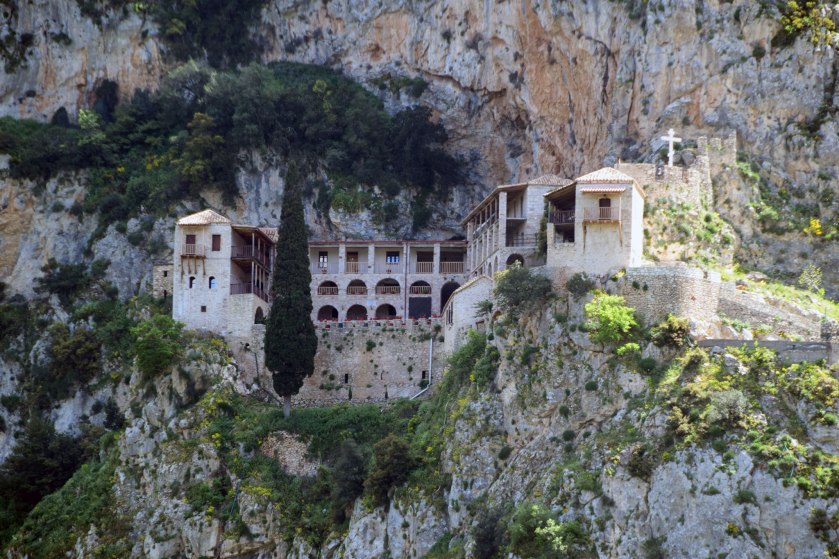
Near the village of Perdikovrisi, in the gorge of the river Tanos, is the monastery of Timios Prodromos. It is built on a steep rock, in an imposing landscape. The monastery is considered one of the oldest in the area, according to the newest inscription (1890) which is built into its main entrance, its historical presence from 1126 AD is testified. The monastery, due to its inaccessible location, served during the Revolution, as a base against the Turks (in the watermill of the monastery they prepared gunpowder), as a military hospital and as a shelter for the civilian population, during the raids of Ibrahim. It is the only one that withstood the siege by Ibrahim’s troops, who besieged it twice without success (there are several relevant reports from Makrygiannis and others). In order to build the monastery complex of Timios Prodromos, the available place was made excellent use of. The buildings leave in the middle a small courtyard which in the background ends at the katholikon and the famous “Cave of the Forerunner”, a last refuge and fortress in case of enemy invasion. In 2002, several restoration works of the monastery were carried out. On the vertical walls of the buildings of the complex are built many sculptural architectural members of the Byzantine period. The katholikon of the monastery is a cave church raised on the second floor of the buildings. Inside, which has a C shape, so that it adapts to the morphology of the cave, its wood-carved iconostasis stands out. Parts of the frescoes are preserved, not in good condition. The few frescoes of the Holy Step (Platytera, Serving Hierarchs) belong to an unknown hagiographer, who probably worked here during the Venetian period (late 17th – 18th century). The monastery is celebrated on September 6 (nine days after the beheading of Timios Prodromos) and on the 14th of the same month, the feast of the Cross
From the “Mount Parnon and Moustos Wetland Management Agency, 2015. Guide for the protected area of Mount Parnon and Moustos Wetland. Nature, Culture, Ecotourism. Astros of Arcadia Parnonas:
The monastery of Malevi is one of the most famous in Arcadia. Built on the slopes of Mount Parnon, at an altitude of 950 m., It is surrounded by dense forest with tree trees. It is located on the road between Astros and Agios Petros and is 26 km from Astros. The monastery owes its name to the highest peak of Parnon, which is known as “Malevos”. Thus, “Panagia tou Malevou” was named “Panagia i Malevi” or simply “Malevi” (For the etymological origin of the word “Malevos” see p. 67). Provided that the date of foundation of the monastery of Malevi is identical with the founding of the other monasteries in the area, it should be placed chronologically at the beginning of the 11th c. As evidenced by a relevant inscription, the current monastery was founded in 1116 AD. by the monk Joseph Karatza, from Sitaina. During the Venetian period, the monastery of Malevi prospered. Before the revolution, the monastery had become a refuge for kleftarmatoles, among them Captain Zacharias Varvitsiotis. In the battle that took place between Greeks and Turks in 1786 AD. the monastery was destroyed. In 1791 AD the monastery is still in operation, despite all the destruction and in 1792 AD. enters it Kallinikos Tsamouris during whose abbotship there was prosperity. Tsamouris, who came from Agios Petros, was an executive of the Friendly Society and had turned the monastery into a hospital. Prince Dimitrios Ypsilantis was hosted here for recovery from tuberculosis. During the following critical years, before and during the Greek Revolution of 1821, the monastery offered great services to the inhabitants of the area and to the fighters.
The monastery today is a huge building complex surrounded by a four-sided enclosure. In the katholikon of the monastery – it is a small single-aisled cross-roofed church with a dome – is the icon of the Virgin Mary. The church, tiled with the octagonal dome resting on a quadrilateral base, has undergone many maintenance operations. In the courtyard of the monastery was inaugurated in 1996 AD. a new church of the architectural form basilica with a dome, dedicated to the Virgin Mary. It has two stone three-storey two-storey belfries on its facade. In the place Pournara, above the monastery, practiced Agios Nilos the Myrovlytis (1616 AD), originating from the neighboring Agios Petros. His memory is commemorated on November 12. Near the monastery is the modern church in his honor. The monastery is dedicated to the Assumption of the Virgin Mary and celebrates on the 23rd of August, in the “Youth (niamera) of the Virgin”, as the locals say on the feast.
Malevi Monastery, is located on the provincial road Agianni Tripoli, after “Xerokambi” where the famous castle of “Oria” can be seen, before the most picturesque and historic Agios Petros Kynourias
“In the area around the Monastery of Malevi, in Kynouria, lies the only forest in Europe made of cedar trees, which has been declared a protected natural monument and is protected by the Natura 2000 network.
The cedar or juniper or Syrian juniper is a rare species, endemic to the Eastern Mediterranean and found in forests only in Syria. Nevertheless, it is characteristic of the flora of Parnon and in this location it is found in a pure cluster of 740 acres. Other rare plant species have been recorded in the same forest, which confirms the uniqueness of the environment in the area.
From the “Mount Parnon and Moustos Wetland Management Agency, 2015. Guide for the protected area of Mount Parnon and Moustos Wetland. Nature, Culture, Ecotourism. Astros of Arcadia Parnonas:
The current monastery of Paleopanagia, is located in a verdant ravine, 7 km from Astros. There was a Byzantine monastery perhaps in another place, honored in the name of Panagia Eleoussi. The monks, due to pirate raids, founded in 1612 AD. new monastery dedicated to the Holy Trinity, as a metochi. Since then, Eleousa received the name Palio-Panagia and in time it developed into an independent monastery. The monastery, which is believed to have been built in 1310 AD, according to written evidence was deserted during the period 1770-1778 AD, while it was renovated in 1799 AD. and later. Built-in early Christian relics (6th century)
The katholikon is a four-aisled cross-roof and was built in 1814 AD. from the second, chronologically, Abbot of the monastery, Nicodemus, who in 1825 AD. added the splint. The octagonal dome of the katholikon rests on four columns and the door of the temple is bordered by hewn stones. Its floor is newer. Above the door of the church is the classic double bell tower. In recent years, its complete renovation has been completed. The wood-carved iconostasis rests on built-in pillars connected with beam and wood beams. There is no painted decoration, but there are remarkable portable icons, such as the icon of All Saints, which reads: Today the monastery is honored at the Assumption of the Virgin Mary and celebrates on the 15th of August
This mountain castle is considered to be the fortress mentioned in the Aragonese Chronicle of Morea as Estella (translation of the Greek word Astros) and has become known by the popular name “Castle of the Hour”, which is found in other parts of Greece, due to the popular tradition regarding its occupation The castle of … Continue reading“Estella Castle or Oria Castle or castle in Xirokambi”
Panos (Akouros) Zafeiropoulos, is one of the most important, or rather the most important Agiannitis before the revolution of 1821 and his contribution to Thyreatida Earth and the homeland is incalculable and passed in the fine print of history, is not mentioned in the history books and is strangely unknown for its great offers in … Continue reading“Castle of Paralio Astros or of Zafeiropoulon”
Kastraki of Meligou is about 3 km from Astros and from there the view of Thyreatida Gis (Thyreas), the whole plain of Astros and Agios Andreas, is enjoyable. At the top of the hill there are crumbling walls from our long history. Kastraki was known in ancient Greece and in medieval times probably with the … Continue reading“Kastraki Meligou”
Castle Paralio Astros , the castle is protected by YA-YPPOT/GDAPC/ARCH/A1/Φ43/41015/2009/8-6-2012, Gazette 196/AAP/13-6-2012″
Our castles, we have many castles ……
When the revolution in the second year showed the difficulties that existed, our English friends sent an admiral to reconcile the wars. What the old man of Moria says below says it all in two words.
We never surrendered, we fought the Turkish conquerors unceasingly for four hundred years in our castles, plains and mountains, and to better understand the admiral continued.
Fire and ax to the collaborators of the conquerors.
The admiral understood well and the meeting ended quickly.
Kastraki of Meligou is about 3 km from Astros and from there the view of Thyreatida Gis (Thyreas), the whole plain of Astros and Agios Andreas, is enjoyable. At the top of the hill there are crumbling walls from our long history. Kastraki was known in ancient Greece and in medieval times probably with the … Continue reading“Kastraki Meligou”
Agiannis took its name from the picturesque church of Agios Ioannis the Forerunner. The church of Agios Ioannis the Forerunner in Agiannis, a large historical monument worth visiting.
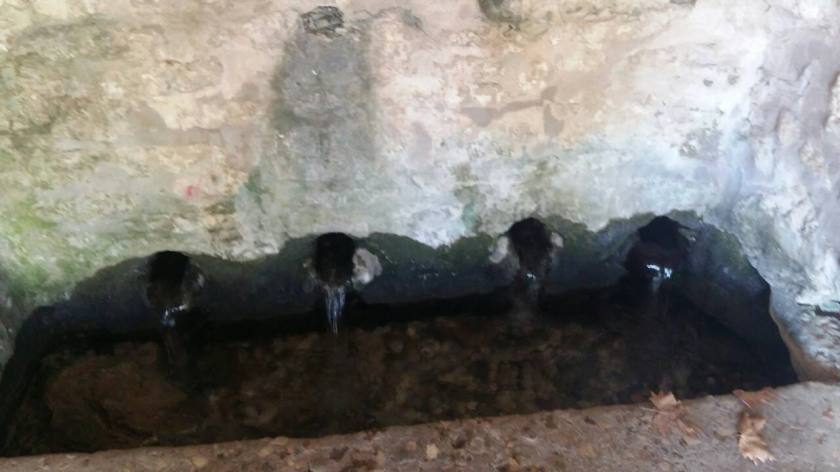
The visitor admires the centuries-old plane tree and the abundant icy water that springs just below the church and flows through five canals, one is very low, as if the water seems to come through the church.
The village “lived” with the abundant water of the precursor. the watermills were working. There were four watermills below the precursor in the row, Dikaios Makarounas, Kordonis, Papoulias Touris and Gardikiotis, under the church of Aelias and it was demolished, whoever remembers let him help>. Down near Agios Dimitrios in the stream there was also the watermill of Stavroulis. Also at the entrance of the village from Astros after the church of Agia Paraskevi there was a mill that worked, not with water, but with oil of Barba Lia Kolovos.
The water of the forerunner, the water of the forerunner was transported away to irrigate the “pergolas” and to live the Agiannites for many centuries.
The summers under the precursor were half the village in their pergolas, it was like a daily festival, some sang or shouted loudly to be heard by those who were far away and of course it was a place of social contacts for the young men and women of the village, somewhere they had to meet and start the sieges by the young people who then had the first say. The watermills ground the grains and at the same time at night they watered the pergolas just below the precursor in the “mills” and during the day the water went to the sougelos that reached Soulinari on the other side of the village. The water was also taken to the streets, it was plentiful, up to the valleys where there was no sugar. The waterers had the first say, but basically everyone went in order.
After the plane tree and before the big cistern there was a laundry room, where the women washed the bed linen and the clothes and generally the clothes of their family.
A few years ago I tried to go down to the “mills” but I could not go further than the second watermill of Kordonis, the paddles reached as far as Ai Lias opposite, now I do not know what is happening. Every year I see the efforts of the friends of the village to clean the paths. In the pergolas everyone had vegetables, tomatoes, zucchini, beans, cucumbers, okra, aubergines, corn, grapes, walnuts, quinces, almonds, apples and other fruits of all kinds. Literally the village “lived” from the forerunner. We do not have photos from the watermills of the village and from the pergolas of “Mylos”, whoever has something let us help. The walk in “Mylos” was once very picturesque and the friends of the village know it and will do something.
From Wikipedia, the free encyclopedia
“The power of water was used by humans as the driving force of mills to crush grain and produce flour.
The watermill or watermill is the first man-made production machine using a natural, mild and renewable energy source. With the power created by falling water from above or its flow and with the help of the wheel, an invention that changed human history, simple and then complex machines were moved, which covered most of the needs of pre-industrial societies, replacing the early machines. human or animal power (hand mills and animal mills), driving forces before water and air. [1] With the watermill and the help of the millstone they also ground the flour. “
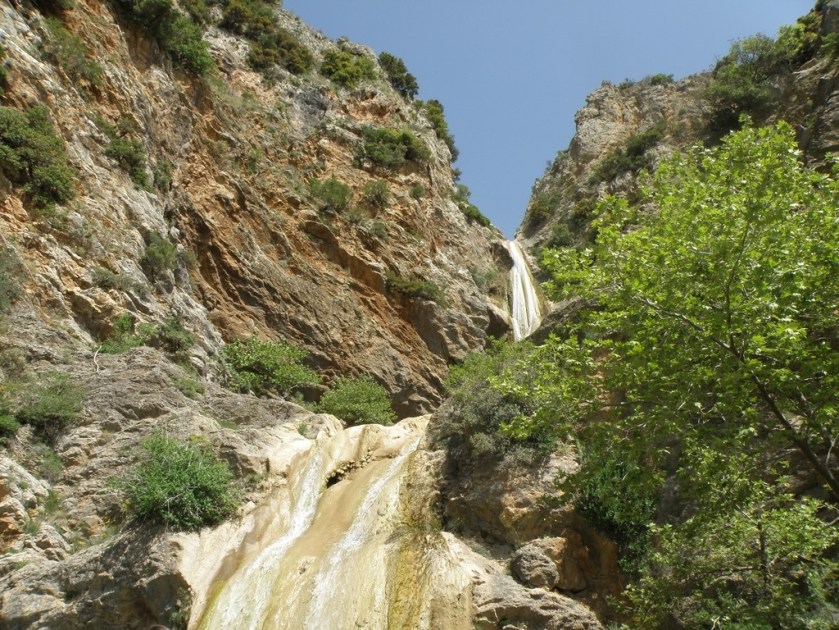
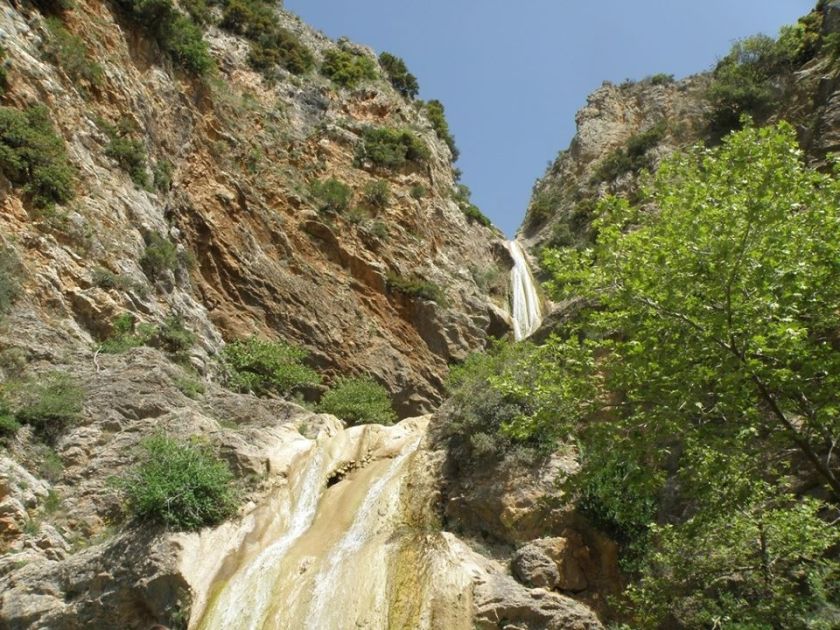
“Lepida Gorge is one of the gorges of the Peloponnese. It is located on Mount Parnonas. [1] Despite its relatively small size, it has a proportionally large waterfall of 70 meters and a smaller 45 meters, which are located at a distance of about 800 meters from each other, following the flow of water. The springs of the waterfalls start from the Xirokambi plateau, between the village of Agios Ioannis and the Holy Monastery of Malevi. The river, descending from the plateau, crosses the gorge and forms small pedestals in its course. [2] [3]
The first waterfall is located at a distance of 3 km from the village of Agios Ioannis. Access to its base is by dirt road and after a short hike on a path of about 200 meters. The second waterfall (eponom Melissi”) is located at a distance of 1.5 km from the village of Platanos, on the road to Astros and at a distance of 19 km from the latter. It is reached after 800 meters of hiking from the nearest highway, following the riverbed. [4] [5]
The ideal time to visit is in the spring, as the flow of water stops during the summer months. Canyoning descents and rappel descents are often organized in the gorge. [6] The castle of Oria is also very close. “
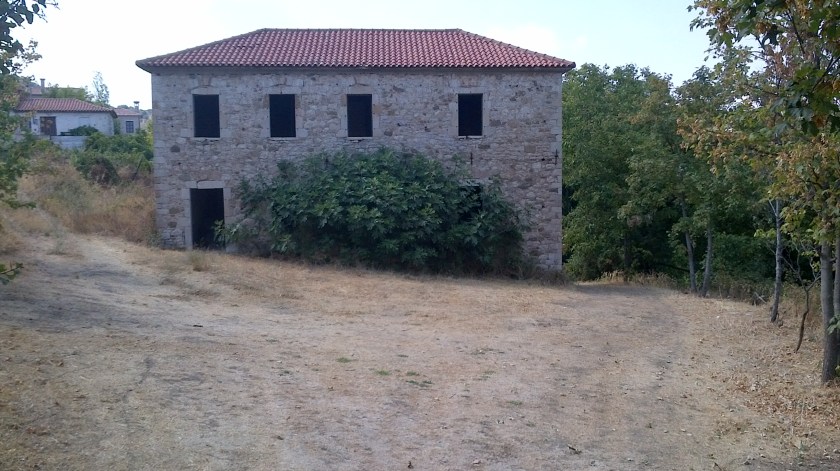
In the photo above is the “old” primary school of Agiannis. The locals called it the “old” primary school, in contrast to the “new” primary school built in the 1960s on the site of Koutri, on the site of the Karytsiotis school built in 1798 and burned in 1826 by Ibrahim.
The “new” primary school built in the 1960s in Koutri, some of our new fellow citizens justifiably confuse “the new” with “the old”, as the locals call them, because in this place was the school Karytsioti, it was the oldest school.
In the above photo taken in front of the old primary school in 1958 by our fellow photographer and barber Thanasis Koutiva? Our late teacher Leonidas Kolovos can be seen with most of the students of the school, some of them were absent that day. Some students are barefoot, in the summer months most of us did not wear shoes… .. say 100 some years, who did what he could to teach us letters. Most of us farming parents raised their children with a lot of effort, love and an ardent desire to learn letters and “change lives”. The students were divided into two classes, the small classes and the large classes. When our teacher was teaching in one class, he was giving a written assignment to the other class and he was sending an older student to the younger ones to supervise the underdog, often the underdog. my lessons, when he sent me to the little ones, but we found ways to cover them; somehow we learned letters, there were other villages where everything was worse.
The bad thing about the school with a teacher, it was our teacher had to cover material at different ages, say to students of 4th grade, for sixth grade also to students of other smaller grades something very difficult, there was no time to cover all the lessons of all classes. The good thing was that the students of the smaller classes had to attend the lessons of the older classes and this for at least some of them was a great opportunity, they were learning advanced lessons.
We all had our nicknames and mine was the “master”, nice nickname indeed, usually the nickname most of the time was related to what you did. I boasted…. and I always said to many who did not know that my nickname came out, that I was master of everything, indeed a man of moderation and consensus for those who know me.…., for this nickname he was “master”.
I want to admit that the reality is a little different, when we had the late teacher Tassos Kalfagiannis as a child, when the school was one with the school of Astros, it happened a bit like that. Our teacher taught a class in a larger class and asked an arithmetic question to the students in the larger class. When I was very young, I jumped up and said.-Kyrgie… Kyrgie… let me say it. The teacher smiled and said: Say “sirgie” “, They forgot Kyrgios…. I will not mention here the details, that later a classmate of mine who did not have such a good nickname as mine…. tried unsuccessfully to change it for me, but everyone continued to call me today “John” Kyrios
Good fun but let’s say something more serious. It is no coincidence that even today we believe in the “Greek measure”, democratic dialogue, national unity and national reconciliation are the only ways that will get us out of the quagmire faster than exaggeration, lies, euphemism and resins for everything.
Ordinary citizens, not experts and professionals in the public, have and must have the first say.
“We can do it if we want.”
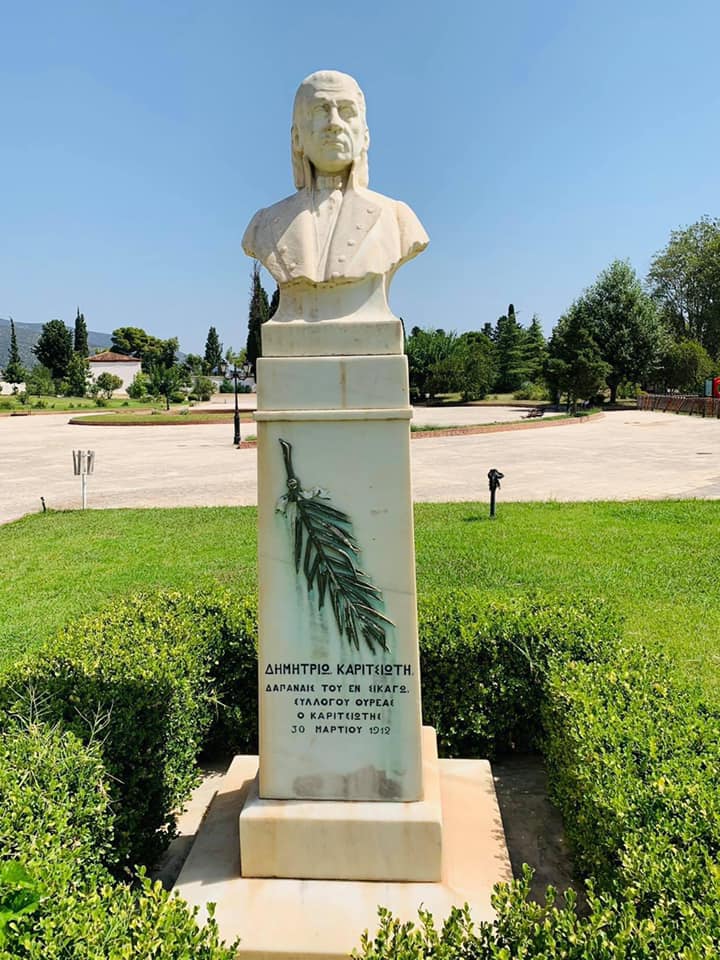
The founding inscription of the Karytsiotis School of Agiannis in practice shows the fervent desire of our ancestors for letters, for “children to learn letters and to change their lives”
«1798 IN THE MONTH OF JULY 18
THE SCHOOL TO PHILOTHEAMON .. “
From the same sigil of 1638 we are informed that Agiannis became a patriarchal exarchate “for the sake of course of the School of Agios Ioannis, operating much older”. According to this passage, a school operated in Agios Ioannis, long before 1638. In Agios Ioannis, there were also “inferior” schools, such as that of Papakyriakos and secret schools, initially in Metochi of the Loukous Monastery, Agios Dimitrios and later in the narthexes of the churches of the village.
The people of Agianni never really surrendered to the conquerors and as a proof of their way they managed to keep their schools open throughout the Turkish yoke and kept the flame of the nation hidden and openly lit.
Ioannis Kapodistrias <1776-1831> studied Medicine, Law and Philosophy. In 1828-1831 he was the first Governor of Greece. As governor he refused to accept a salary, while he disposed of all his property for the purposes of the state.
His first involvement with politics began in the Ionian State, where he served from 1801 to 1806 in various positions.
In 1809-1814 he worked as a consultant and follower in the Ministry of Foreign Affairs of Russia and in 1814-1822 he was Minister of Foreign Affairs of Russia.
On March 30, 1827, at the Third National Assembly of Troizina, he was elected Governor of Greece for a term of seven years.
On January 18, 1828, ten months after the decision of the Third National Assembly of Troizina, he arrived in Nafplio, where he was enthusiastically received and four days later in Aegina, the first capital of the Greek state. According to Kasomoulis, “it was night, and the night of January 18 in Nafplio passed with joy of all the people and melancholy of only a few distinguished aristocrats”.
Most historians consider Kapodistrias’ work important, but do not fail to mention the authoritarianism with which he exercised power. His patriotism is recognized by almost all historians. Regarding his patriotism, Takis Stamatopoulos concludes that “to be fair we can not deny his good intention, his amazing and ambitious hard work to create a state out of chaos.”
Inside the country, with his arrival, Kapodistrias had to deal with the war with the Turks, piracy, non-existent institutions, the dissolution of the army, the civil strife, as well as the poor economic situation of the country.
In addition to the most pressing economic, social and diplomatic problems, Kapodistrias had to face two important obstacles in his policy of building the fledgling Greek state.
First, the hostility of France (after 1830) and England, whose geostrategic interests in the Eastern Mediterranean were jeopardized by the prospect of creating a new and dynamic naval and commercial state beyond their control or, worse, under Russian influence.
Secondly, the factions and the local, economic and political interests of the Kotzabasids, Phanariots and shipowners, who sought to maintain the privileges and participate in the prefecture of power.
Eventually the combination of the above factors prepared the ground and led to the political and physical extermination of the first Governor of Greece on October 9, 1831.
In order to effectively manage the tragic economic and social situation of the new state, Kapodistrias advocated a centralized model of power, in order to maintain direct political control. The opposition against Kapodistrias was made up of the Kotzabasids and shipowners who ousted from power. Responding to the allegations, he spoke of other priorities, such as establishing schools (mutual schools, technical schools) and distributing arable land to the poor landless. In this way (education and securing resources), he believed that the Greeks would be freed from the slavery of the exploitation of the few and would become ready to enjoy full, political rights.
France and England, considering Kapodistrias a close friend of Russia, encouraged the opposition.
The center of the anti-Kapodistrian struggle became Hydra, the seat of the shipowners and more specifically of the Koundouriotis family, which had on its side the fighters Miaouli, Sachtouri, Tombazi, Kriezides.
The main reason for the reaction of the Hydra shipowners was their demand for the “non-deferred” payment of compensation for the great damages and losses of their ships during the Revolution. Recognizing the fair demand immediately, Kapodistrias promised that as soon as the country’s finances improved, Hydra would receive “its share as long as the law required it”. The Hydraeans, however, demanded the immediate payment of these compensations, which was impossible due to the poor financial situation of the state.
On July 14, 1831, Miaoulis and Kriezis with 200 Hydra soldiers occupied the naval base in Poros because they learned that the fleet was ready to move against Hydra.
And while the English and French admirals, obstructing, sailed to Nafplio to meet with the ambassadors, the Russian admiral Ricord undertook to implement, alone, the instructions of Kapodistrias. He expelled the guerrillas, came into conflict with them, blew up the “Island of Spetses”, captured another ship and finally expelled Miaoulis to the “great crime”. On the morning of August 1, 1831, Miaoulis, as Rickord had warned, blew up two of the most modern ships of the Greek navy at that time, the frigate “Greece s “and the corvette” Hydra “.
D. Hoidas, in a letter to Augustinos Kapodistrias, from Tripoli, on August 10, 1831, among many other important information about the tragic situation that prevailed throughout the country, wrote that the people of Hydra said that “they frigated it (Greece ) they burned it with the permission of the British ambassador, as he promised to give them another “and the Nafplio police had information” that the two ambassadors (of England and France) took part with the Hydraeans and that they wrote to Rickord to stop their hostilities against them until the proxy sent by the three powers, that is, the English admiral, of the fate of the Aegean Sea, arrives “
In addition, the leader of the English party, Alexandros Mavrokordatos, and Spyridon Trikoupis, Anastasios Polyzoidis and Alexandros Soutsos took refuge in Hydra, having the moral support of the pro-French Korai. The organ of this opposition group was the newspaper Apollo by Polyzoides.
Kapodistrias himself was aware of the plans of the specific foreign forces against him. On July 31, 1831, in a letter to the French Admiral Lalande, who was serving in Greece, he revealed to him that he knew all the intrigues of the English and the French: no way to cut the thread of cooperation with you, because I gave priority to the recovery and reconstruction of Greece. If I cut ties with the so-called “protecting” Forces, this would be to the detriment of Greece and I did not want to add weight to my conscience in any way. And I left things to their own devices. “
As early as the previous year, in 1830, a riot had broken out in Mani under the leadership of Tzanis Mavromichalis, Petrobei’s brother. The latter was placed in confinement in Nafplio, asked to go to Mani to calm her down, his request was not accepted, he tried to escape by English ship, he was arrested and imprisoned. Seriously bearing this treatment of the head of their family, and in the tense climate from the events of Poros, Konstantinos and Georgios Mavromichalis, brother and son of Petrobei respectively, applied the Mani custom of the vendetta. On the morning of September 27, 1831, according to the Julian calendar (that is, October 9, 1831), outside the church of Agios Spyridon, they shot and stabbed the governor Ioannis Kapodistrias while he was going to attend the Sunday Divine Liturgy.
The tragic death of Kapodistrias plunged the agricultural population into grief, while on the contrary in Hydra they received the news with celebrations.
For the murder of Kapodistrias, the Swiss philhellene, friend of Kapodistrias and benefactor of the revolution, I.G. Einardos said: “As soon as he killed Kapodistrias, he killed his homeland. His death is a disaster for Greece and a European accident “
It has been claimed that foreign powers France and England played a catalytic role in his assassination.
Much later, in 1840, Petrobeis Mavromichalis himself, hearing someone accusing Kapodistrias, is said to have said these words: “You do not count well, philosopher. a man who will not find him, and his blood educates me until now… ».
One of the killers, Konstantinos Mavromichalis, shortly before he died from the pistol of Kapodistrias’s guard, asked for mercy and said to the police: “It is not my fault, other soldiers put me in the army”. The contemporary with the events, historian and fighter Nikolaos Kasomoulis, reports that the other executor of the Governor, George Mavromichalis, took refuge in the house of the French ambassador Baron Rouen, stating: “We killed the tyrant. We believe in the honor of France. Here are our chariots “.
Count Gobino is one of the three greatest diplomats of the time, along with Metternich and Talleyrand,
Kapodistrias had been honored many times by Tsar Alexander.
Today many streets and squares bear his name. The State Airport of Corfu is called “Ioannis Kapodistrias”, while from 1911, at the request of the benefactor Ioannis Dombolis, the National University of Athens was renamed “National and Kapodistrian University of Athens” and in the Propylaea there is a statue of him.
There is also a statue in the central square of the town of Capo d’Istria (present-day Koper) in Slovenia.
Ioannis Kapodistrias is considered a national hero of Switzerland, because as Russia’s representative in Switzerland he contributed to the unity and independence of the Swiss state. He was one of the inspirers of its division into 19 autonomous states, the cantons, helped and influenced the formation of the Swiss constitution, but also the neutrality of the country.
“He participated in the Vienna Conference as a member of the Russian delegation and later representative of Russia at the Paris Conference in 1815, where he succeeded in neutralizing Austrian influence, the integrity of France as well as the international neutrality of Switzerland.
It is worth noting here that Switzerland’s gratitude to the first Governor of Greece does not only extend to the granting of citizenship, but also recently, the city of Lausanne made another honorable move.
Together with the Russian government, the city of Lausanne, in September 2009, unveiled the bust of Ioannis Kapodistrias, in the presence of Swiss Foreign Minister Micheline Calmy-Rey and Russia, Sergei Lavrov, the Mayor of Lausanne and Pascal Broulis, president of the local parliament of the canton of Vaud, whose capital is Lausanne.
The bronze bust, the work of Russian sculptor Vladimir Surovchev, was erected in Lausanne “as a token of honor to the city’s first Honorary Citizen”.
It was an act carried out jointly by Russia and the city of Lausanne, and the revelations coincided with the official visit to Switzerland of Russian President Dmitry Medvedev. “
Sources
From Wikipedia, the free encyclopedia and iefimerida.gr
Ioannis Kapodistrias <1776-1831> did his job in the best way, everyone recognizes him and his critics… dot.
“In difficult times our only allies are our ancestors”
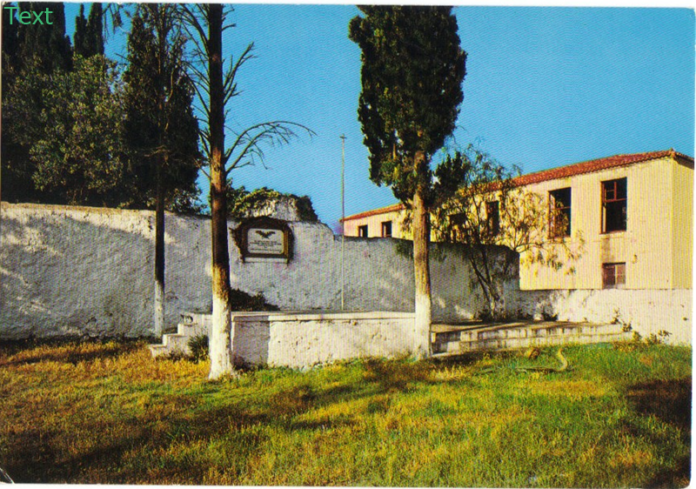
On June 19 – 20, 1821, the local chiefs had a dinner, the well-known “Kolokotroneiko dinner” in Astros to Prince Dimitrios Ypsilantis and important revolutionaries leaders Theodoros Kolokotronis and others. in the farm of Karytsiotis under the hill, which still exists and dies slow, and in the area there is a relevant sign, next to the School of Karytsiotis of Astros (now Archaeological Museum of Astros). There, Panos Zafeiropoulos told Prince Ypsilantis that he had sworn not to cut or shave before the homeland was liberated. Then Ypsilantis asked him: “So you will stay Akouros ??”. This is how the well-known nickname “Akouros” came about. Zafeiropoulos, in fact, kept his oath.
Kolokotronis said at the dinner to Dimitrios Ypsilantis that here we eat with the “golden spoons and golden forks” which were the hands and the pumpkin cups …..
Like today, on September 25, 1849, the most glorious and noble of all the fighters of 1821, Nikitas Stamatelopoulos, the legendary Nikitaras, dies blind and very poor in Piraeus.
For the Greeks he was the famous Turkophagus, while for his comrades-in-arms he was the poor Nikitas, who never agreed to take booty. His appearance on the battlefields aroused the enthusiasm of the Greeks and caused real terror to the Turks, who retreated, chanting only on his shield with a sword in his hand. Pure and selfless, he never agreed to get the slightest pay, even when his family was hungry. As Georgios Gazis, Karaiskakis’ grammarian, wrote, “Nikitas used gold to chase the enemy, happy to be called a glorious penny rather than a rich ignorant one.” After the revolution, when Nikitaras was asked why he never took his loot and now lives in such poverty, Nikitaras answered sternly “I was not a negotiator. My destiny wanted me to become a Captain. And it would not be right for me to make a note of my Captain in order to make a mess! “
For Otto and the Bavarians, the Bavarian locust as the common people called them, Nikitaras was more than dangerous. Not only because Nikitaras had stood wholeheartedly by the side of Kapodistrias, but mainly because in his face the ragged Greeks still found their heroic idol, the fearless lad who embodied their honor and pride. That is why the Bavarian parastate arrested and imprisoned him, subjecting him to horrific torture. And when his youngest daughter, in whom Nikitaras had a pathological weakness, saw her father being brought in tattered clothes on a stretcher to the courtroom where he was being tried, she lost her mind and from then on she went crazy saying “nice that you are all red My father”…
When, after public pressure, Nikitaras returned blind from the exile sent to him by Otto, he was forced to ask the government for a small welfare allowance for the first time in his life in order to be able to meet his daughter’s medical expenses. The government refused the allowance and gave him only a begging permit to beg every Friday afternoon outside the church of Evangelistria in Piraeus. Thus, the demigod of Dervenaki stood raked and blind every Friday afternoon in the churchyard and begged…
At dawn on September 25, 1849, Nikitaras’ wonderful heart stopped beating. His house in Piraeus was immediately flooded with crowds, as all ordinary people spontaneously came to see for the last time the legendary Nikitaras. In his small will he left only his sword to his son John and declared his last wish: to be buried next to his uncle Kolokotronis, in the First Cemetery of Athens.
Something unexpected happened on the day of the funeral. Outside the hideout there was a chariot that would transport Nikitas’ body to Athens. But as soon as the body came out on the doorstep of the house, the infinitely gathered crowd burst into tears and his old comrades who had initially lifted the body, did not put it in the cart but handed it to the countless anonymous Greeks who volunteered to stand up. the body of Nikitas. Thousands of men, young, old and children lifted the body successively and so, from back to back, the body was transported from Piraeus to Athens, while flowers fell on the coffin from the balconies of the houses where the huge procession passed. In this majestic and unique way, an entire Nation rose on its back and led this wonderful man to eternity. Only the Greeks could give such an honor to a dead man and such an honor could only be given to Nikitaras…
Unfortunately, today we do not know exactly where his tomb was, as well as what happened to the bones of Nikitaras. But as the historian Dimitrios Kampouroglou wrote, who tried in 1926 to find the tomb of Nikitaras, “Let the Greeks be comforted by the thought that for Nikitaran all the Greek Land has open arms”….
Today marks two hundred years since the great event of the Fall of Tripoli that justified the strategic planning of Theodoros Kolokotronis, overwhelmingly imposing the prevalence of the revolution in Moria during the crucial first year of the great uprising of the Genos.
Tripoli was the great Turkish city of Moria founded by the Ottomans after 1461, who to show the grandeur of the city gave it the Old Turkish name of the gardens of Islamic paradise, while to emphasize the mighty Ottoman military power within of its walls they called it “the Doors of the Lion”. For the Greeks it was just “poor Tripolitsa”, because in its surroundings there was the terrible palukorachi, where the Ottomans beat the Greeks alive by the hundreds, while in the center there was the terrible “Platanitsa of Tripolitsa”, where they hung the captains and .
The significance of the Fall of Tripoli lies not only in the justification of Kolokotronis’ strategic planning but also in the fact that the initial successes of the Elder of Moria in Valtetsi, Vervena and Doliana, caused chain political developments in Paparis, Chrysovitsa, Kaltez. which led to the formation of the Peloponnesian Senate and the first state reconstruction of Hellenism since the fall of Constantinople in 1453.
This is exactly where the concept of conquest instead of liberation comes into play. The only cities for which Hellenism uses the term conquest are Constantinople and Tripoli. In 1453 Byzantine Constantinople was conquered by the Ottomans, while in 1821 the Ottoman misery Tripolitsa was conquered by the Greek revolutionaries. In 1453 in Constantinople the state status of Hellenism was catalyzed, while in 1821 in Tripoli the state status of the Ottomans was catalyzed and the state status of the Nation was revived. In 1453 in Constantinople we had the burial of Hellenism and in 1821 in Tripoli we had a national uprising. Konstantinos Paleologos symbolizes the glorious end and Theodoros Kolokotronis the glorious Polygenesis. That is why Theodoros Kolokotronis is the greatest figure of Modern Hellenism after the time of Constantine Paleologos.
Immediately after the Fall, Tripolitsa lived about 4 years of freedom but in a regime of factionalism and civil war. Her liberator Theodoros Kolokotronis was imprisoned and its first mayor (political and military commander), Panos Kolokotronis (son of Kolokotronis) was killed. Until 1825 the city was conquered again by Ibrahim. After 3 years of new bloody struggles, Theodoros Kolokotronis re-entered the city as a liberator on February 18, 1829, after Ibrahim had leveled it. But even after the assassination of Kapodistrias and the imposition of the Bavarian Kingdom, the last act of the drama of Greek independence was to be played again in Tripoli. After the death sentence of Kolokotronis, the rebellious Moraites wanted to occupy Tripolitsa with the Vlach Revolution (or Messinian Revolution) and were suffocated in blood by the Bavarians, Kolletis and Mavrokordatos. Many of Moria’s fighters who fought the Ottoman dynasty and the Egyptian conqueror were sentenced to death and executed as traitors in 1834.
The heavy historical heritage of Tripolitsa is the one that imposed the way the city was liberated in 1944 by the German occupation forces and their sad Greek collaborators. Tripoli is the only Greek city that, following the order of the Greek Government of Cairo and the assent of the Allied Headquarters of the Middle East, ELAS entered the city as a liberating National Army, preventing a new civilian massacre like that of Meligalas.
Tripoli is not a simple city. It is the towering milestone of the national and political identity of the whole of Modern Hellenism. According to the science of history and archeology, Old Tripolitsa no longer exists. Tripoli has taken its place, which is nothing more than a creation of the Bavarians. Perhaps that is why the national and political message of the city has faded so much nowadays and with it the national and political identity of modern Hellenism has faded. However, in the souls of its people, who still feel “Drompolitsiotes” and not “Tripolites”, the same flame that Theodoros Kolokotronis lit inside them and lit that Friday morning on September 23, 1821, illuminating the road to freedom, is still burning. of the Genus…
Like today, May 12, 1821, Kehagiabeis leaves the army from Tripoli, led by the infamous Roubi, to hit Valtetsi and cross to Kalamata, suppressing the Revolution in Moria.
Kolokotronis has lined up the Maniates, the Messinians and the barren Dredes in Valtetsi, all of them the deadliest rifles in Moria, to anchor the Turks and force them to develop around the village. There, Kolokotronis himself will strike them with flanks in a decisive battle, coming with reinforcements from Karytina, the terrible swords of Moria, from the neighboring camps of Chrysovitsi and Piana, while the trap will be completed with the reinforcements that will come from the north. famous swordsmen of Prastos, who will block the escape of the Ottomans to Tripoli. Geros narrates the plan “I told you to make the drums closed. At the edge of the village was a church, to give birth to a tambourine, as well as two waterfalls that dominate the village, where if the Turks come you can be locked inside. They answered me: we are lost! You shut up and I will come to you immediately (with reinforcements) “. The Turks hit Valtetsi mercilessly but the Greek rifle sparkles. The fierce battle continues until noon, when Kolokotronis arrives with reinforcements from Chrysovitsi. From a back he makes a loud voice to the old man Mitropetrova, the best rifle of Messinia, who was in Valtetsi: “Vasta barba Mitro”! Those detained in Valtetsi understand that aid is coming…
In the afternoon, Plapoutas arrives with the help of Piana. At midnight, Kolokotronis supplies the village with naval energy and returns to his drum, shouting loudly for the Turks to hear him: “Hey, old Turks! I am Kolokotronis! I will catch you alive! ”, While he puts several men circling the hills with lighted torches to show that reinforcements are constantly coming. Fotakos narrates: “the war continued unabated all night”. At dawn the reinforcements from Vervena arrive and the battle is now decided.
At dawn the war continued for four hours, when the Turkish troops showed a decline. Rubis sent a coded message to Kehagiabei to retreat, burning gunpowder from his drum. Kehagiabeis agreed, also burning gunpowder from his own drum. Kolokotronis realistically understands the intention of the Turks to retreat. He jumps from his drum standing up and pulls his sword from the holster, shouting with all his might: “Up to the Greeks” !!! And then, a supernatural glow covered the whole of Valtetsi! It was the reflection from the blades of the Greek swords that unfurled and faced the midday sun…
It was afternoon when the Greeks stopped slaughtering the Turks in the plain of Boleta. The Ottomans ran in panic to Tripolitsa to be saved. The Old Man narrates: “We chased them until we took them out to the plain. That war stood the happiness of the homeland. If we got lost, we were in danger of becoming a horde (camp) now “. In order not to endanger the Greeks from the remains of the Turkish cavalry, Geros shouted: “Enough Greeks! Let us kill in other battles as well “!!!
That same night, the leader of the Turkalvanias who fought in Valtetsi, Liobeis, narrates the events in Sarai and says in the presence of all the Turks, addressing the beautiful Marigo, the tortured Greek girl of the harem “Oh, but the god, it is yours! I had fought in so many seferias (wars) with the Tsamides, the Souliotes and the Muscovites (Russians)! But the rifle I saw in Valtetsi is youthful! Go, now go! It’s yours! Your goddess “saw” it! Kolokotronis confesses “I said that we should all fast for the praise of that day and be glorified for centuries, until the nation stands, because it was the freedom of the homeland”…
Delirium of excitement prevails in the Greek camp. Everyone now recognizes the correctness of Kolokotronis’ plan. The Old Man, however, is restrained. He knows that Kehagiabeis will move immediately to Mistra. And this road passes through Vervena and Doliana…
We boldly borrowed the excellent text from a friend.
On April 25, 1821, Kehagiabeis of Khurshid Pasha has completed his destructive work in Patras, Vostitsa, Corinth and is outside Argos, ready to level the Greek revolutionaries.
At the hearing of Kehagiabei alone, most Greeks scatter. Few remain to defend Argos and make tambourines in the bed of Haradros or Xeria, a dry river outside the city. Among the defenders is Giannos Giannouzas and his people from Spetses, the brave eldest son of Bouboulina, who together with his mother besieged neighboring Nafplio.
The few and ignorant in the land war, however, defenders of Argos are disbanded by the select and bloodthirsty Turkalban horsemen of Kehayabei. Last is Giannos Giannouzas with his Spetsiotes, who give an epic fight fighting hand to hand. Giannouzas rushes on foot on horseback to Bali Bey, the arrogant and famous Turkalvan, and throws him home. Giannouzas stands up, grabs the kneeling Bali Bey from the sariki and is ready to take his throat, but a Turkalban shoots him in the back and throws him dead. Bali Bey gets up and beheads the dead Giannos Giannouza. The Turkalvans are chanting…
Bouboulina learns the news and after the battle she goes with her bodyguard to look for Giannos. Walking among the dead and wounded, she recognizes her child’s headless body. She takes off the scarf she was wearing in her hair, covers her headless body, hugs it and kisses it. He tries not to bend. She is carried away by the groans of a nearby wounded Turkalvan, who begs for some water. Bouboulina gets up, pulls arrogantly the pistol she always had in her belt and executes the Turkalvan on the spot…
She orders her soldiers to load her child’s lifeless body on the horse. And returning to her grammar, she orders him to write a letter to the political authorities of Spetses with the simple message: “My son is dead, but Argos is in our hands”…
Text: George Th. Prachalias
Paintings:
Bouboulina and the historical map of Argos with the Gorge (Xeria)
In the above old map, Agiannis is mentioned as Astros, while Astros is mentioned as Agios Ioannis. Astros and Paralio Astros came from the village of Agios Ioannis, as well as other settlements. Astros and Agios Ioannis (Agiannis) were for at least seven hundred years and from the first organization of the Greek state administratively a community, as today, and most importantly the inhabitants of Agiannites and Astrinos are the same inhabitants, they had and still have houses in Agianni and Astros. The municipality of Thyreas, based in the settlement of Agios Ioannis, was established with the initial organization of the Greek state in 1835, Government Gazette 16A – 24/05/1835. Later in 1841 the settlement of Astros is defined as the winter seat of the municipality and the settlement of Agios Ioannis is defined as the summer seat of the municipality, Government Gazette 5A – 08/03/1841.
Thucydides called the states Athenians, Corinthians, Spartans, and did not call them Athens, Corinth, Sparta . Citizens were states, not cities and castles. In our long history the inhabitants were the cities and the villages. The Shield, the Greek (or Wall). The Gate, from the gate, was the door between the first European city of Argos and Sparta.
From the Municipality and Wikipedia.
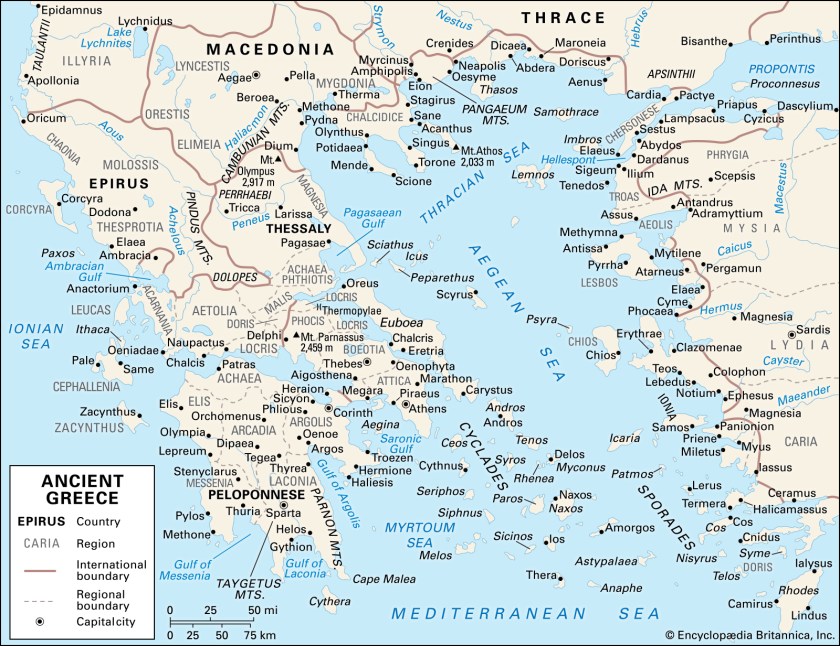
At a distance of about 8 km from Astros at the top of the hill above the bends “kodelles” a short distance from the uphill road to Agiannis is the Greek Wall, from there the view of Thyreatida Land and the Argolic gulf is excellent. At the point there is an inscription of the archeological service that leads to a rural road and after 2 kilometers the visitor reaches a plateau, which is the beginning of a 15-minute walk that leads to the top of a hill, the Wall or Elliniko. Here one can see the ruins of the ancient sanctuary of the god Apollo, ruins of walls, buildings and underground tanks and relics of Thyrea. Thyrea was inhabited for the first time in the Early Helladic years by the Danes and after the Mycenaean years it was inhabited by the Ionians. . From the 8th century onwards, Kynouria was stubbornly claimed by the Spartans. After successive conflicts we reach one of the most shocking battles in Greek history, the battle that took place in 546 BC. and went down in history as the “Battle of the Shield” or the “Battle of 600 Logades” in which the Spartans were the winners.
Thyrea, the Greek (or Wall) can be seen on the above map of ancient Greece.
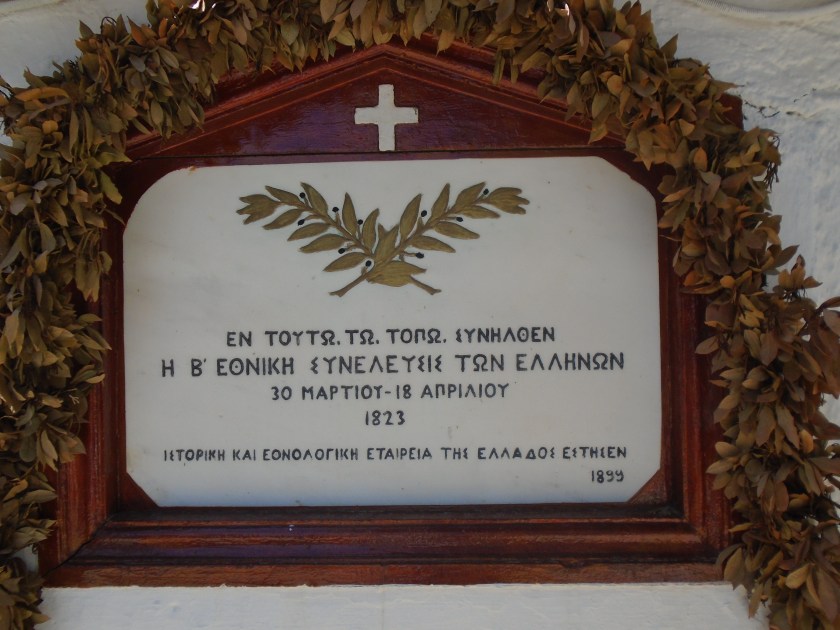
Smaragdi I. Arvaniti briefly and succinctly tells us, as we understand it, the “Holy Space” of the Second National Assembly of the Greeks in the historic Astros is the most important historical monument of our place, which we must promote and distinguish where we can.
See more in the links, for the importance of the National Assembly in Astros, by Smaragdi I. Arvanitis,
Our fellow citizen Giannis D. Kourbelis and astros-kynouria News with their excellent work and in the best way say everything about the story of Agiannis, in the following links.
From the astros-kynouria News by Giannis D. Kourbelis =======================================
The most important things we need to know. All links below are in Greek
Ιωάννη Μ. Αρβανίτη – Από τις Πηγές του Λαού μας, τόμος A,Β, Αθήνα1985,1988
Ιωάννη Μ. Αρβανίτη-Η Επαναστατική Προσωρινή Διοίκηση της Ελλάδας στον Άγιο Ιωάνη (Αγιάννη) Β.Κυνουρίας -20 Αυγουστου εως 1 Οκτωβριου 1822
Σμαράγδης Ι. Αρβανίτη – Οι σχολές του Δημητρίου Καρυτσιώτη στον Άγιο Ιωάννη και το Άστρος Θυρέας – Κυνουρίας κατά τα προεπαναστικά χρόνια έως την απελευθέρωση, Εταιρία Πελοποννησιακών Σπουδών, Αθήνα 2001
Σμαράγδης Ι. Αρβανίτη – Μελέτες Βυζαντινής και Μεταβυζαντινής Αρχαιολογίας και Τέχνης προς τιμήν της καθηγήτριας Ελένης Δεληγιάννη-Δωρή. Ο μεταβυζαντινός ναός του Αγίου Γεωργίου στον Άγιο Ιωάννη Κυνουρίας συνοπτική παρουσίαση του μνημείου και του εικονογραφικού προγράμματος, Αθήνα 2010
Σμαράγδης Ι. Αρβανίτη -Το κάστρο του Παραλίου Άστρους Κυνουρίας πρώτες παρατηρήσεις, Αθήνα 2007
Αναγνώστη Κονδάκη –Απομνημονεύματα, εκδόσεις Βεργίνα, Αθήνα 2009
Σταύρου Αθ. Κουτίβα –Περί την διαθήκην του Δημητρίου Καρυτσιώτου, Αθήνα 1958
Ευστρατίου Ι. Δαλιάνη –Ξεδιπλώνοντας τον χρόνο: Αγιάννης – η άγνωστη πρωτεύουσα της Ελλάδας,Αθήνα 2016
Αρχεία Εθνικής Παλιγγενεσίας
Χριστίνας Κουλούρη –Η βιβλιοθήκη της Σχολής Καρυτσιώτη,Εταιρία Μελέτης Νέου Ελληνισμού, Αθήνα 2009
Εγκυκλοπαίδεια Νέα Δομή, τόμος 13ος, εκδόσεις Νέα Δομή, Αθήνα 1996
Χρονικά των Δολιανών Κυνουρίας, τόμος Β’ – Η Μάχη των Δολιανών (19 Μαϊου 1821), Αθήνα 1962
ALL THE WORLD KNOWS THE HISTORICAL ASTROS FROM THE SECOND NATIONAL ASSEMBLY OF THE GREEKS and the event has been included in the official celebration program of the Commission “Greece 2021” and is under its auspices.
We welcome the Commission “Greece 2021” and the common mind, which will eventually prevail.
The “Holy Space” of the Second National Assembly of the Greeks is undoubtedly one of the most important historical monuments not only of Kynouria but also of our homeland.
“Greece 2021”
We are pleased to announce “The” Holy Place “of the 2nd National Assembly of the Greeks” and code GR-01724, IS HERE IN FRONT OF US,…
“No. Protocol: 4210
Dear Mr. Kourogiorgas,
We are pleased to confirm that we have received your proposal entitled “The” Holy Space “of the 2nd National Assembly of the Greeks” and code GR-01724, which we intend to include in a special edition that we are preparing and will include a description of all the proposals identified with the four axes of the Commission and which contribute to this common national undertaking on the occasion of the 200th anniversary of the Revolution of 1821. Your written consent for this publication, as provided in the current legislation, will be requested in the second year.
With regard to the possibility of the Commission supporting your proposal, we will contact you shortly after the final plenary session and the Commission’s assessment of the financial means available.
Thank you very much for your participation in the national call. “
We wish you happy holidays, happy new year and health.
When will you post, according to
your tourist program, on the website of the municipality two photos with two words, the sign of the “Sacred Space” of the 2nd National Assembly and the plaque of the Karytsiotis school in Agiannis;
Please give us the protocol number. Thank you.
John Kourogiorgas
We got the A.P.
Protocol number: 16815 / 14-12-2020
How to do it this. many of our fellow citizens in the vast majority, let not all of our fellow citizens say, we do not believe that the most important sights of our municipality to be mentioned on the website of our municipality are the Port of Agios Andreas, the Greek (or Wall ), the ruins of the Castle of Oria, the Gorges of Mazia and Zarbanitsa, but they are much more important that should also be mentioned the two most important monuments of our municipality, the School of Karytsioti of Agiannis with its branch in Astros (which houses the museum Astros) and the “Holy Space” of the 2nd National Assembly of the Greeks, full stop.
See the disgrace of seven years in the following link from the website of our municipality. We show these and these are seen by our visiting friends. ‘Mercy now, Mr. Mayor, please implement your program or otherwise answer reasoned in accordance with the constitution and the legislation on Protocol number: 16815 / 14-12-2020. Enough…….
We are pleased to announce that the “Greece2021” Commission has decided to include in its electronic version the most important historical monument of Kynouria and our homeland, GR-01724 “The” Holy Place “of the Second National Assembly of the Greeks”.
The whole dunias and the “Greece2021” committee know “the historic Astros of Kynouria” from the 2nd National Assembly of the Greeks. The “Holy Space” of the Second National Assembly of the Greeks is undoubtedly the most important monument of Kynouria but also of our homeland.
We have information, we are not kidding, that soon the Commission “Greece2021” and other public authorities ….. will demand from our deputy mayor for tourism Mr. G. Gardikiotis and our mayor Mr. G. Kampilis to execute orders of our fellow citizens, to do what they have promised, to do the obvious and to post according to the tourist program, on the website of the municipality two photos with two words, the sign of the “Sacred Space” of the 2nd National Assembly and the plaque of the school Karytsiotis to Agiannis and also to include the above in accordance with Greek legislation in the Operational Program of our municipality 2020-2024.
The “Greece2021” Committee thunderously tells us in every direction that the “Holy Space” of the Second National Assembly of the Greeks is here, in front of us.
On Monday, November 22, 2021, 04:13:42 a.m. EST, Secretariat Greece 2021 <secretariat@greece2021.gr> wrote:
No. Prot. 012909
Dear Mr. Kourogiorgas,
As the anniversary year draws to a close, we would like to thank you on behalf of the Greece 2021 Committee for your response to the call to celebrate the 200th anniversary of the 1821 Revolution by submitting the GR-01724 proposal to the Commission. “The” Holy Space “of the Second National Assembly of the Greeks”.
The enthusiastic participation of the Greeks and the many friends of Greece, prove their deep love for the country.
Unfortunately, despite the Commission’s efforts, the special circumstances prevailing during the anniversary year with the corresponding impact on financial and sponsorship opportunities and the change of priorities due to the current pandemic, have not made it possible to finance the implementation of a significant number of proposals, including of your own.
Nevertheless, the Commission, in order to honor and highlight the wide participation of society as a whole and of each individual in the celebration of the anniversary, but also to leave a historical record for the future, is preparing a special electronic edition with the recording of the basic elements (title, type of proposed action, name of the body / person who submitted it) of all the proposals submitted and which correspond to the context of the anniversary celebration that had been set. Please let us know by November 30 if you have any objection to including your above proposal in this version.
Thank you again for your participation and we wish you every success in your work.
We are pleased to confirm that we have received your proposal entitled “The” Holy Space “of the 2nd National Assembly of the Greeks” and code GR-01724, which we intend to include in a special edition that we are preparing and will include a description of all the proposals identified with the four axes of the Commission and which contribute to this common national undertaking on the occasion of the 200th anniversary of the Revolution of 1821. Your written consent for this publication, as provided in the current legislation, will be requested in the second year.
With regard to the possibility of the Commission supporting your proposal, we will contact you shortly after the final plenary session and the Commission’s assessment of the financial means available.
Thank you very much for your participation in the national call. “
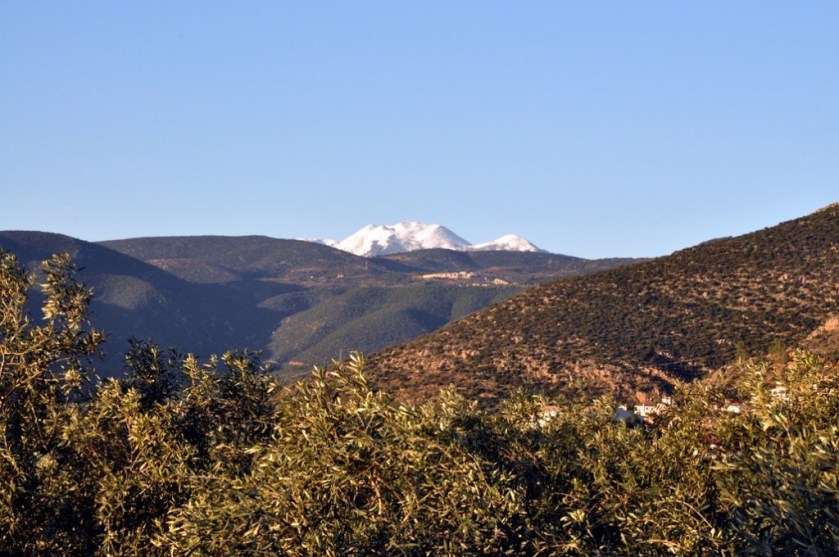
The name Parnonas means bright glow, from the light of the second sun or from the light of the moon.
Flora
The area of North Kynouria can rightly be described as a botanical paradise with great ecological value. Although a complete and systematic record of the flora of Paronon has not been made, it is certain that more than a thousand species and subspecies grow from its foothills to its peaks. 113 rare plants have been recorded, unique in Europe and 16 local endemic, ie plants that are not found anywhere else in the world. The rare aromatic and medicinal plants of Parnon, known since antiquity, add another dynamic to the flora of the area.
The top of Mount Parnon is one of the most attractive destinations for climbers. The existence of the mountaineering refuge of Parnonas in Arnomousga, on the border with the prefecture of Laconia, has contributed greatly to the development of mountaineering and hiking tourism in the area.
Mountaineering routes
The following routes that have been formed and marked in the municipality of North Kynouria are of great interest for fans of the genre: ·
The path from the shelter to the top of Parnon.
· The path from the plateau of Parnon to the Monastery of Malevi.
· The “national path 33” that crosses the western part of the municipality, starts from Agios Petros and ends at the cape of Malea.
· The international path E4 that passes through the northwestern part of the Municipality.
From the village of Ano Doliana and through forest roads it passes through the place Zygos and continues to the prefecture of Laconia and the village of Karyes. A detour leads to the village of Agios Petros where there is a possibility of accommodation and dining. ” Just behind Ai-Lias is the second highest peak … The highest peak Tourla is right From Wikipedia, the free encyclopedia Parnonas – Malevos, Altitude 1,934 meters Peak Megali Tourla or Kronio The name Parnonas is ancient and etymologically related to the names of the mountains Parnassos and Parnitha. It means a bright peak, from the light of the second sun or from the light of the moon. It is also called “female mountain”, because it is smoother and gentler than its “big opponent”, Taygetos .
Malevi Monastery, is located on the provincial road Agianni Tripoli, after “Xerokambi” where the famous castle of “Oria” can be seen, before the most picturesque and historic Agios Petros Kynourias
“In the area around the Monastery of Malevi, in Kynouria, lies the only forest in Europe made of cedar trees, which has been declared a protected natural monument and is protected by the Natura 2000 network.
The cedar or juniper or Syrian juniper is a rare species, endemic to the Eastern Mediterranean and found in forests only in Syria. Nevertheless, it is characteristic of the flora of Parnon and in this location it is found in a pure cluster of 740 acres. Other rare plant species have been recorded in the same forest, which confirms the uniqueness of the environment in the area.
In the 1960s we went to Ai Lia from Agiannis and slept one night there, on July 20 at his feast
From wikipedia Lepida Gorge is one of the gorges of the Peloponnese. It is located on Mount Parnonas.
[1] Despite its relatively small size, it has a proportionally large waterfall of 70 meters and a smaller 45 meters, which are located at a distance of about 800 meters from each other, following the flow of water. The springs of the waterfalls start from the Xirokambi plateau, between the village of Agios Ioannis and the Holy Monastery of Malevi. The river, descending from the plateau, crosses the gorge and forms small pedestals in its course.
[2] [3] The first waterfall is located at a distance of 3 km from the village of Agios Ioannis. Access to its base is by dirt road and after a short hike on a path of about 200 meters. The second waterfall (called “Melissi”) is located 1.5 km from the village of Platanos, on the road to Astros and 19 km from the last. It is reached after 800 meters of hiking from the nearest highway, following the riverbed.
[4] [5] “KRONION PASSAGE-70 KM DEFENSE RACE.
The Municipality of North Kynouria, The Management Body of Mount Parnon – Moustos – Mainalo & Monevasia, The local community of Agios Petros Kynouria, with the help of local agencies and professionals of the Community And with the kind participation of the APS Association. Apollon West Attica and the Spartan Runners as technical advisors of the race, ANNOUNCE THE 70 KM DEFENSE RACE. IN PARNONA WITH THE NAME KRONION PASSAGE – RUNNING TO THE SACRED MOUNTAIN OF KRONOS – THE FATHER OF THE GODS » FROM THE MYTHIC PELOPONNESE Vamvakou – Parnon Shelter – Megali Tourla – Malevi Monastery
“The marked path starts from Vamvakou, at 960 meters altitude, on the slopes of Parnonas, requires a course of 2 hours and leads to the mountain refuge of Parnonas, at 1,450 meters. From the shelter, the marked route continues to the top of Megali Tourla, the highest peak of Parnonas, at 1,935 meters altitude, and ends at the plateau of Kampos which wants another 30 ‘walk to the top. The length of the route is 9.5 km and the ascent takes a total of 4 hours. In the end, you head north to the village of Agios Petros which is all you need for what you need, rest and good food. ”
Sitaina: The villages of Parnonas are beautiful
See below Mount Parnon and Moustos Wetland Management Agency
The villages of Parnonas were Christianized around the 9th century and out of excessive respect many added the word Agios to their name, such as Agios Ioannis, Agios Petros, Agios Nikolaos, Agios Andreas, Agios Vassilios, Agioi Asomatoi, Agios Paneos Agios , Kosmas and filled the place with churches and monasteries. They also called many sites “holy”. For this reason Parnonas was also named “Mount Athos” of Southern Greece.
Agios Ioannis (Agiannis) before the revolution of 1821 had a total of 16 churches along with the chapels around the village, this says something about the respect of the inhabitants and the prosperity of the village for many years.
The church of Agios Georgios is a post-Byzantine church located in the central square of Agiannis, with the big plane tree. The church celebrates every year on April 23 on the feast of St. George the Trophy Bearer or on Easter Monday (if Easter falls after April 23).
In 1982 the church was designated by a decision of the Ministry of Education and Science as a “Historical Preserved Monument”, while it was designated as a “Post-Byzantine monument”.
According to many researchers, the church of Agios Georgios was built during the 14th – 15th century, ie it is modern or a little older than the church of Prodromos. However, some others consider the church much older, due to the style of the paintings inside.
The church was originally a chapel of the village, the village was for many years lower, in Soulinari and Prodromos. The houses of Agiannis timidly began to ascend in Sarantapsychos to the church of Agios Georgios about 250 years ago and more after 1940 with the opening of the Astros-Tripoli highway.
Agiannis was the capital of Greece of the Provisional Government of the Revolution, from August 15 to October 1 and “the Soulinari neighborhood was the metropolis of Agiannis”.
The church of Agios Vassilios was a large church which was located at the bottom of the village and specifically at the place of Matthew and near the source of Soulinari. The church, which was the metropolis of the church, was completely destroyed in 1826 and in its place today has been erected a simple shrine… .. “The church together with its surrounding area were the metropolis of the village, as we see that in the surrounding area there are many mansions of important Agiannites (such as those of Perros, Sarigiannis, Matthew etc. (of the Zafeiropoula brothers)) and various churches (Agios Efstratios and Agios Petros) ”
The church of Agios Georgios was burned twice by the Turkish conquerors in 1687 and 1826 and survived due to its stone construction, unlike the other churches of Agiannis that were completely destroyed by Ibrahim in 1826. (Agios Vassilios, Agios Efstratios and ).
“In March 1687, Agios Ioannis was set on fire by the Ottomans, along with many neighboring villages such as Meligou, Kastanitsa, Korakovounika and Prastos. We are informed of this fact by the following passage: << In the month of March, 1687, Meimet Pasha came by order of Serasker Ishmael Pasha, who was in Patras, to the Tsakonians, and I did not want to take him to the villages. Saint John, Meligos, Kastanijan, Korakovouni and Praston, and great damage was done to the Christians >> »
The church has a total of 142 admirable icons inside, mainly in the lower ones the saints were “blinded” by the swords and the hatred of Ibrahim in 1826. The frescoes are probably works of the priest of Agiannitis and painter Georgios Koulidas.
Near Aigiorgis in the central square is a two-storey elongated building, with loopholes, which, according to tradition, was used as a “Government” for the establishment of the Revolutionary Government, from August 22 to October 1, 1822. This period is also confirmed by the Archives. of Lazaros and Georgios Kountouriotis (vol. AD, p. 92 ff.).
In the central square next to the church for at least three hundred years the “trikouverta” festivals and endless big dances with many rows “from all over the village” took place. The feast of Aigiorgis in Agiannis was a great festival of the area. The young people adorned with their “good” horsemen on their also adorned horses with the colored rosaries and the “mantanias” turned Aigiorgis three times, boasting and squinting at their girls and then left running ostentatiously with pride to Lainas, to return again later this time very slowly still on horseback to confirm that they were all noticed.
The women, mainly the young ones adorned with their goodies and others, started dancing jumping, like descendants of Paianas and Dionysus, singing in a large line the dithyramb “the song of Lambros” also boasting ostentatiously “to turn Aigiorgi” and at the end to begin the big dance in the square, “where the whole village danced” and the barba Panos Katsianos with the clarinet, cleverly encouraged with the air “we sell them The other organ players to play non-stop for “the world to dance”.
“Forty-two thieves are chasing Lambros and Lambro, out of fear of Aigiorgi, goes to bed. My Saint George, I escape with the hands of the Thieves. To bring liters of candle and incense of frankincense with the buffalo to carry the oil “
On the three sides of the temple there is the famous “terrace” where the “men” sat in front of the chairs, when they went to the square for fun and gossip. In the “terrace” of Aigiorgis the lords of the village met for many years and in 1822 the officials of the provisional Government of Greece. Later, next to the “terrace” in the summers under the mulberries the “Athenian” holidaymakers Agiannites and the “Tsiopeloi” from Astros, with the white shirts and the mangoes, in the chairs of the cafe “To trick” played backgammon, kolitsina, dry, prefa, kumkan and squared the circle with endless “stories” such as “I want the same herring” and the “goat with the violin” in Katsoulis the mulberry. In the 1950s, kumkan was banned from gambling, but Agiannis or “little Paris” was “free Greece” because he had replaced the police with the excuse for a joke of Agiannites “Policeman” Loufolias with the loan cap of a gendarme without in Korona, there was no police in Agiannis. Besides, the Agiannites students of the Karytsiotis school were devoted to their gambling activities from 1824.
“During the years of the Revolution of 1821, the school operated with difficulties. According to a letter from the representative of the Ministry of Religion on July 20, 1824, the students of the School “instead of going to study”…. τοῦτο ἐταράχθη και ἐφριξεν! ». Thus, the Ministry, learning about the situation of the School, issued an aphorism to the students.
Since we mentioned mangoes and white shirts above, let us clarify. In “Little Paris”, Agianni, in the 1960s, many “Athenian” Agiannites and the Astrian “tsiopeli” came to spend their holidays. The people of Agianni also had a love for letters for hundreds of years and many young people were educated and also came to vacation in “little Paris”. Almost everyone wore white shirts and most had mangoes “ostensibly to represent the villagers” with the pegs. The graphic “madman of the village” and “policeman” of Loufolia called them, among other things, white shirts. At that time, they used to say in “little Paris” for fun, characteristically, “if you throw a mangoura, you will hit ten white-shirted teachers”.
Opposite Aigiorgis is the large plane tree that had the big, eloquent and very strong bell that called the people of Agianni to Aigiorgis for hundreds of years, which broke strangely recently.
Sources
Πηγές
Ιωάννη Μ. Αρβανίτη – Από τις Πηγές του Λαού μας, τόμος A,Β,Αθήνα1985,1988
Σμαράγδης Ι. Αρβανίτη – Μελέτες Βυζαντινής και Μεταβυζαντινής Αρχαιολογίας και Τέχνης προς τιμήν της καθηγήτριας Ελένης Δεληγιάννη-Δωρή. Ο μεταβυζαντινός ναός του Αγίου Γεωργίου στον Άγιο Ιωάννη Κυνουρίας συνοπτική παρουσίαση του μνημείου και του εικονογραφικού προγράμματος, Αθήνα 2010













 astrosgr.com - Το Ιστορικόν Άστρος Κυνουρίας